W.P. Phillimore & Phillimore's Marriage Registers
W.P. Phillimore
Phillimore, born William Phillimore Watts Stiff, was the son of Dr Stiff, a Nottingham Doctor. He later took the name Phillimore from the family of his grandmother. He became an Oxford-educated lawyer, and founded a British and Scottish Record Society along with the Canterbury and York Society. After he resigned from these societies, he turned his attention to his native country, and began the transcription and printing of marriage registers. When he died in 1914, he had covered 1200 parishes from different counties in 200 volumes.
Phillimore was also a publisher of books relating to ecclesiastical law. He went on to found Phillimore & Co. Ltd in 1897 in central London. For over a century this company has been publishing British local and family history. They stock several hundred books, and the books would be very useful if someone is researching the history of regions, counties, cities, towns, or villages.
Phillimore's Marriage Registers
This is a series of books published in the late 19th and early 20th centuries by Phillimore & Co. Ltd. However, these registers do not cover all the parishes or complete dates - this depends on the surviving registers and the ones Phillimore collected, so there may be some omissions. In some counties, the coverage of parishes is very good, whereas in other counties just a few parishes were transcribed - most counties do not have every parish transcribed.
The original parish records are usually stored in a county record office. These can be viewed by the public, but the archivists are reluctant to allow handling of these old and unique books.
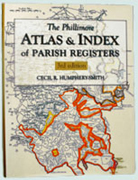
The Phillimore Atlas and Index of Parish Registers
This guide to parish registers, iis a vital, time-saving tool that has become universally known as 'the genealogist's bible'. It covers England, Scotland and Wales. The Atlas includes the famous county 'parish' maps, which show pre-1832 parochial boundaries, colour-coded probate jurisdictions, starting dates of surviving registers, and churches and chapels, where relevant.
Topographical maps face each 'parish' map, and show the contemporary road system and other local features, to help deduce the likely movement of people beyond the searcher's starting point.
This book also indicates the whereabouts of original registers and copies. It also gives registration districts and census information.
The user may quickly find answers to such questions as: Have the registers been deposited? Where may they be found? What outside dates do they cover? Have they been copied or indexed and by whom?
This product is available from S&N Genealogy Supplies.
|